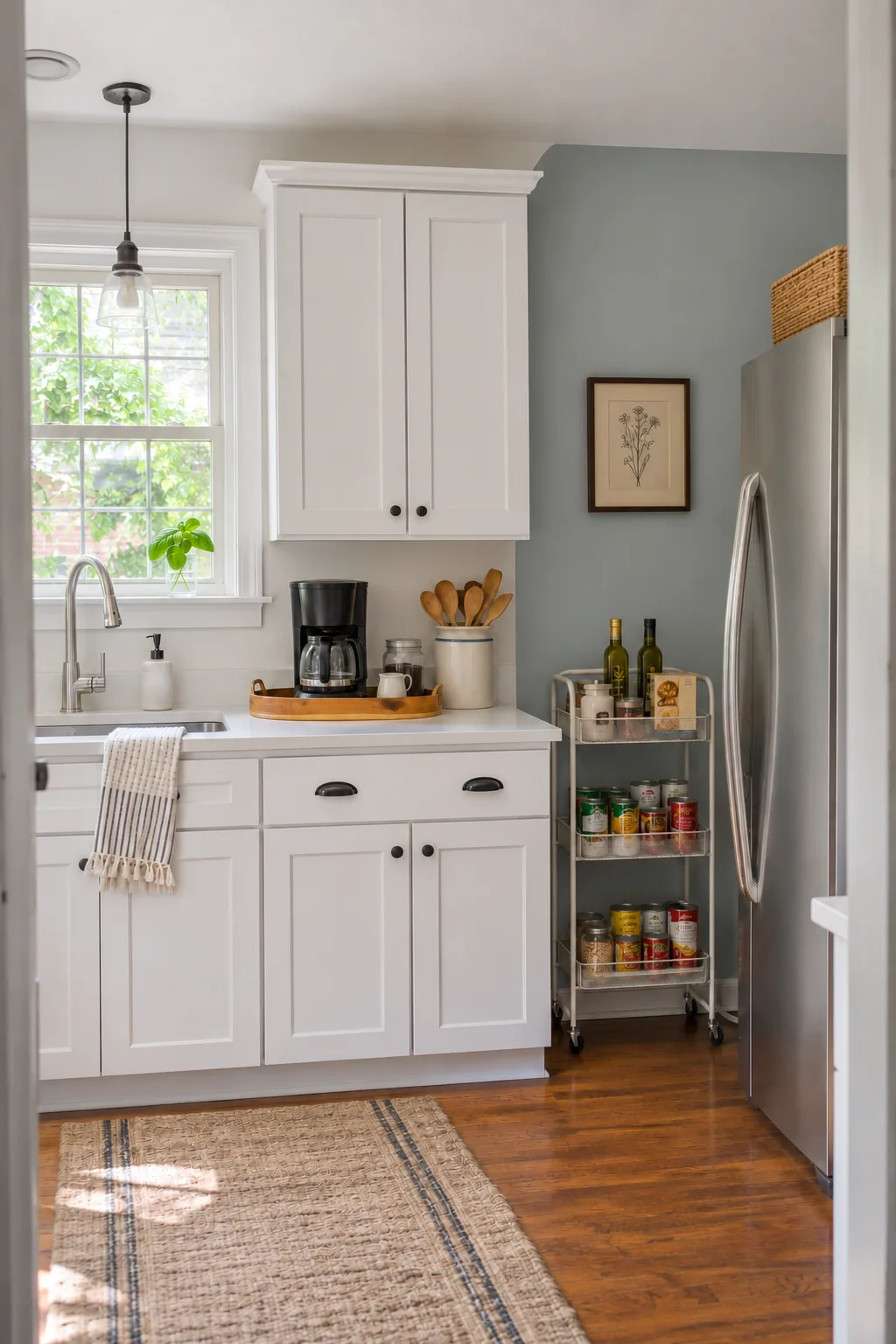
A small kitchen with no pantry can still feel calm. Good kitchen organization ideas start with the real problem: food, spices, and tools have no real home, so they land on the counters, and the whole kitchen feels full before you even start cooking.
This matters to me because of how a space feels. When a kitchen looks cluttered, the mind and the heart start to feel cluttered too. A small kitchen can still feel cozy and pretty, in the taste of the person who cooks there. When everything has a place and the counters have room to breathe, cooking feels lighter, and so do you.
You do not need a pantry closet to get there. You only need to build a pantry out of the small spaces you already have: inside doors, beside the fridge, on walls, and in one calm corner. And every idea here has a no-drill option, so it works in a rental too.
First, build your pantry zones
Before you buy anything, take everything out of one cabinet at a time and group things together. As you empty each cabinet, set aside anything expired, duplicated, or never used, so only the food you really eat gets a zone. Put dry food in one group, spices in another, then oils and sauces, then baking things. When you see the groups, you can give each group one zone. A zone can be a shelf, a bin, a cart, or a door. That is your pantry now, just spread out in small places instead of one big closet.
1. Use the inside of cabinet doors
The inside of a cabinet door is free space most people never use. A simple door rack or a few small hooks can hold lids, spice packets, wraps, and measuring spoons. These are the little things that usually get lost in drawers and make cooking feel messy. Renting? Choose a rack that hangs over the top of the door, or adhesive hooks that come off clean. Hang it, then close the door slowly and check that the door still shuts and nothing knocks against the shelves behind it.
2. Put a slim rolling cart in the gap
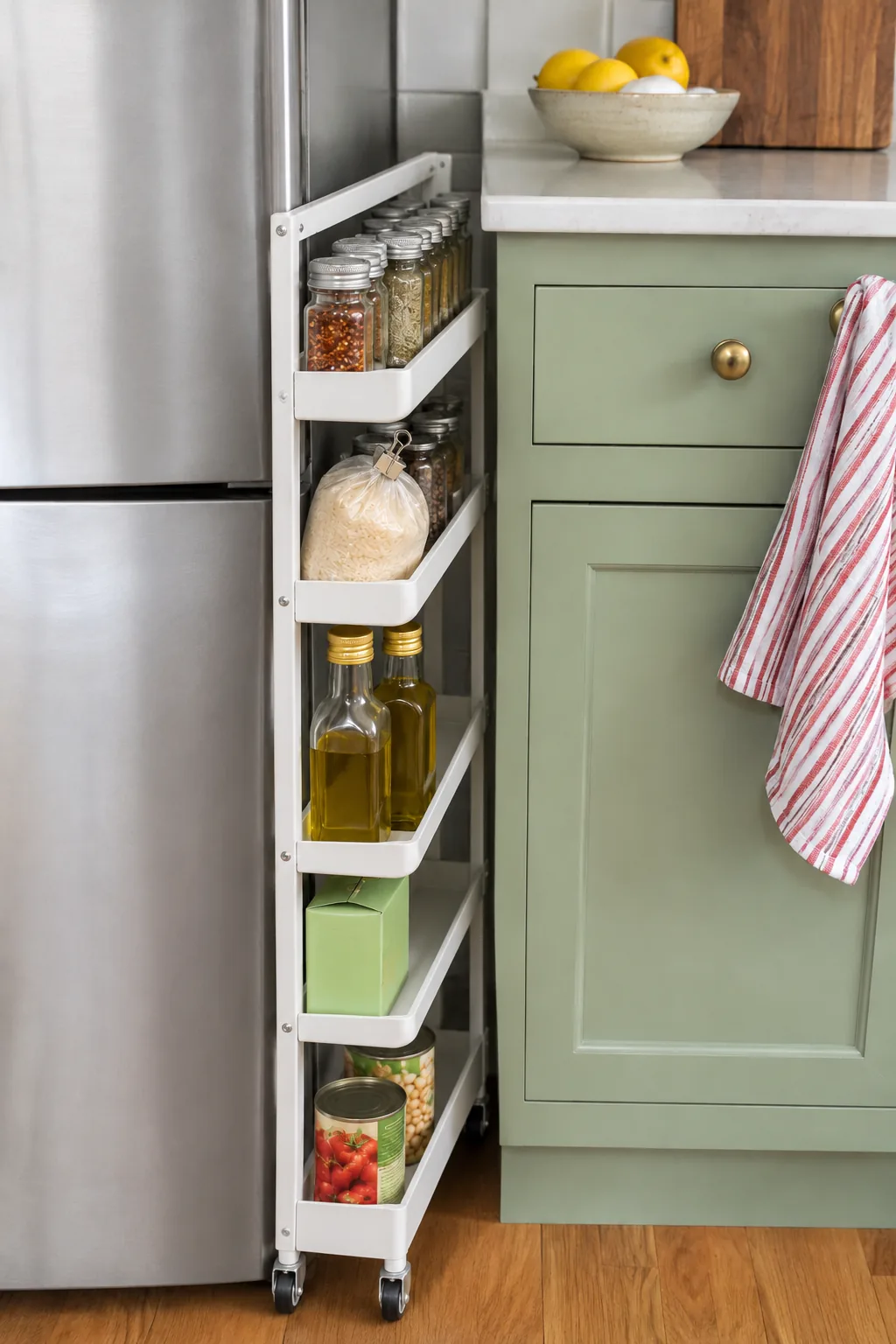
Many small kitchens have a narrow gap next to the fridge or the stove. A slim rolling cart fits in that gap and holds cans, oils, and jars. You pull it out, take what you need, and roll it back. Hidden space becomes real pantry space.
3. Add shelf risers inside cabinets
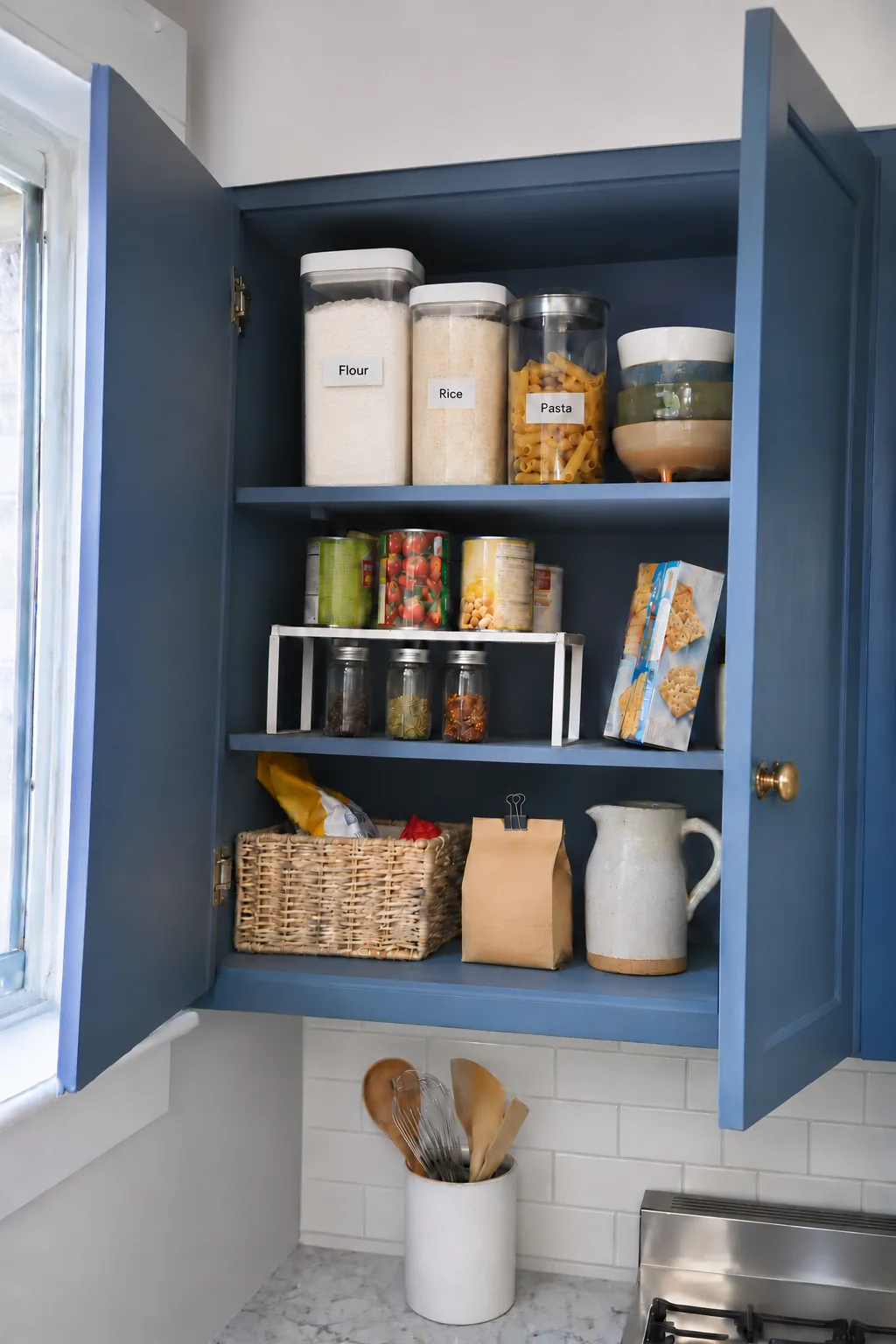
A cabinet shelf holds one layer of food, and the space above it goes to waste. A simple shelf riser gives you two layers instead of one. Short cans and jars go on one level, taller things on the other, and you can see everything at once.
4. Use a turntable for oils and spices
Oils and spices love to hide in the back of a cabinet. A turntable, also called a lazy Susan, brings the back to the front with one small turn. No more buying the same spice twice because the first one was hiding.
5. Move dry food into clear containers
Rice, pasta, beans, and flour behave better in clear containers than in half-open bags and boxes. Rigid containers can waste a little room, so choose sizes that fit your shelf well. What you gain is a shelf you can read at a glance, and airtight lids keep food fresh longer. Add a simple label with the name, and your small pantry starts to feel like a pretty little store shelf.
6. Hang utensils on a simple rail
Big utensils eat a whole drawer fast. A simple rail on the wall, with a few hooks, holds ladles, spatulas, and scissors where you can grab them. The drawer stays free for smaller things, and your cooking tools stop fighting each other. If your walls are off limits, use an adhesive rail or a rail hung on a tension rod, or stand the utensils in a sturdy crock by the stove.
7. Put spices on the side of the fridge
Magnetic spice tins can stick right on the side of the fridge. That side is usually empty, and spices are small, light, and easy to lose in a cabinet. In tins, they stay visible and easy to reach. Test the side with a magnet first: many stainless steel fridges are not magnetic, and a fridge set between cabinets has no open side at all. And keep the tins away from the stove’s heat, because heat makes spices lose their flavor faster.
8. Use the wall for pots and pans
Pots and pans are the biggest space eaters in a small kitchen. A small pegboard or a wall rack holds them up and frees a whole cabinet for food. Hang only the ones you use every week. The special ones can live in a bin up high. If you cannot hang anything, a freestanding pot rack or a lid organizer inside the cabinet does the same job without a single screw.
9. Hang a pantry organizer on a door
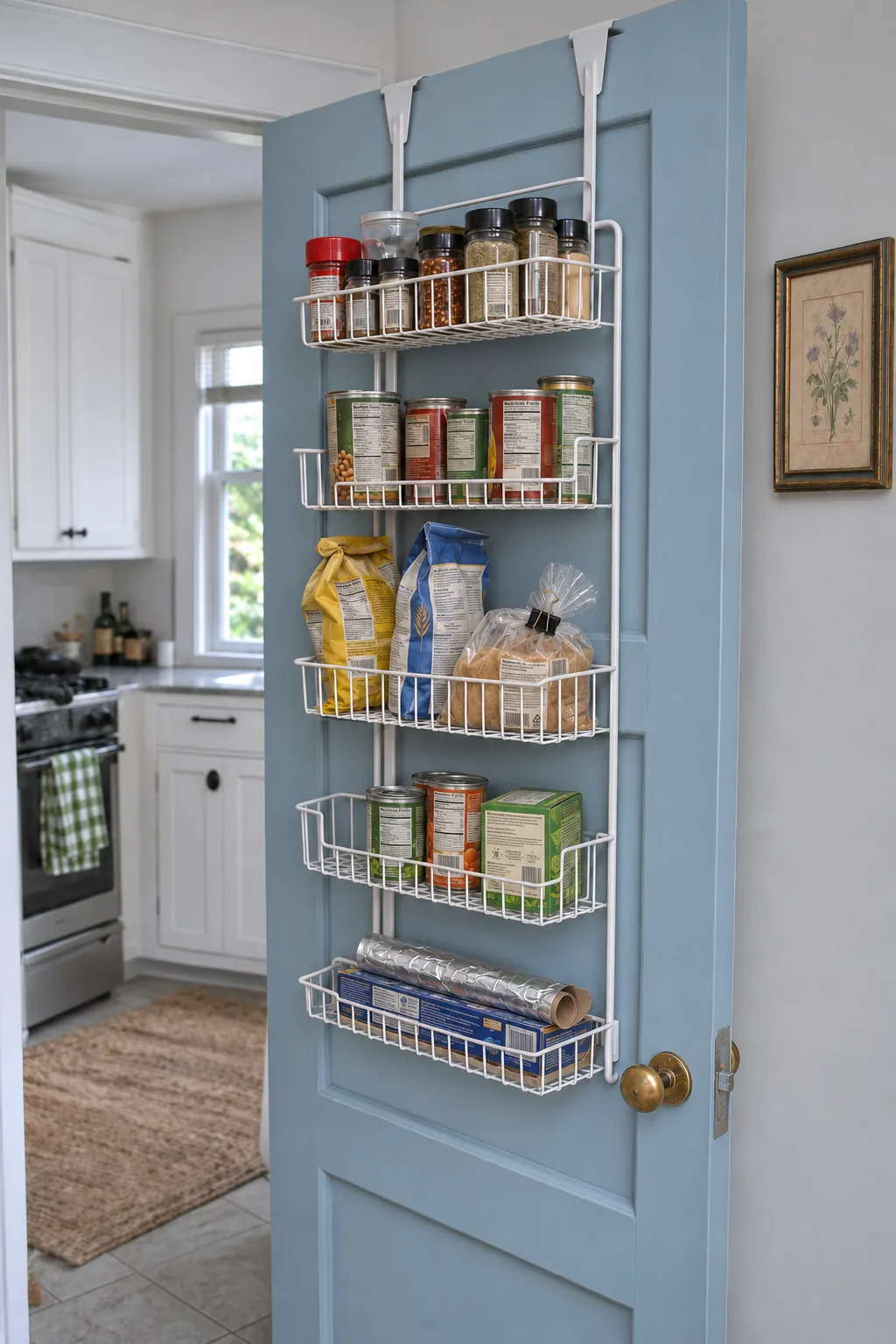
A closet door or the kitchen door can hold a whole pantry. An over-the-door organizer with clear pockets or wire baskets hangs from the top of the door, no screws needed, and holds cans, packets, snacks, and jars where you can see them all. It is one of the fastest ways to gain pantry space in a rental, and when you move, it comes with you.
10. Use the space above the cabinets
The space between the cabinets and the ceiling is good for things you rarely use: the big party tray, the holiday dishes, the extra mixing bowls. Put them in matching baskets so the space looks neat and finished, and keep everyday food down low where you can reach it.
11. Create one pantry corner
Take one small shelf unit, a cube organizer, or a sturdy bookcase and make it your pantry corner. Food goes in baskets by group: one for cans, one for pasta and rice, one for snacks. A curtain in a soft color can cover it if you want it hidden. One corner, organized well, works like a real pantry. A shelf full of food is heavy, so anchor it to the wall with an anti-tip kit. Many kits use small screws, and many landlords allow those. Ask first if you are not sure. If screws are not allowed, choose a low unit, like a two-shelf cube organizer, that does not need anchoring.
12. Keep the counters almost empty
This is the idea that changes how the whole kitchen feels. Keep on the counter only what you use every single day. Everything else goes to its zone. Group your daily things in one small station, like coffee things together on one tray. Clear counters make a tiny kitchen feel bigger and more open, and cleaning takes minutes. A mirror or a light peel-and-stick backsplash helps too, bouncing light around the room so the kitchen feels brighter.
If this list feels like a lot, start with just two ideas: the slim cart and the clear counters. Those two alone change a small kitchen fast. Then add one idea at a time, on another day, at your own pace.
If you want help keeping track of your new pantry, our Home Planner has a Tiny Pantry Inventory, a Small Fridge Inventory, and a Small Kitchen Storage Zones page, and Day 3 of the 7-Day Cozy Reset walks you through a tiny pantry and fridge.
Questions people ask about kitchens with no pantry
Where do you put food in a kitchen with no pantry?
You build a pantry out of the small spaces you already have. Food lives in zones: dry food in clear containers inside a cabinet, cans on a slim cart beside the fridge, snacks and packets in an over-the-door organizer, and the rest grouped in baskets in one pantry corner.
How do you make a pantry in a small apartment without drilling?
Every idea in this article has a no-drill option. Over-the-door racks hang from the top of the door, adhesive hooks and rails come off clean, a tension rod can hold a rail, and freestanding carts and low shelves need no anchoring at all.
What is the best storage for a kitchen with no pantry?
The best storage is the kind that fits the space you have and the way you cook. For most small kitchens, the strongest start is a slim rolling cart for the gap beside the fridge, clear containers for dry food, and one pantry corner with baskets, because those three give food a real home fast.
That is the heart of The Cozy Footprint: a kitchen does not need to be big, and it does not need a pantry closet, to feel calm and cozy. Give everything a home, use the hidden space you already have, and let your counters breathe. When your kitchen feels lighter, you feel lighter too.
What you need for these ideas
- Slim rolling cart
- Cabinet door rack
- Shelf risers
- Turntable
- Clear food containers with labels
- Wall rail with hooks
- Magnetic spice tins
- Small pegboard or pot rack
- Over-the-door pantry organizer
- Matching baskets
Want more cozy organizing help? Get the free Cozy Home Starter Kit.